
Is Lane Splitting Legal in New York? What VTL § 1252 Says
Contents
Last reviewed: October 18, 2026. This article is general information, not legal advice. New York traffic laws can change; check the current Vehicle and Traffic Law before you ride.
If you have sat on a bike in Long Island Expressway traffic, or idled at a light on Broadway behind a row of cabs, the gap between the cars can look like the obvious way out. In New York, it is not a legal one, and the law says so in plain words.
Short answer: Is lane splitting legal in New York? No. New York Vehicle and Traffic Law (VTL) § 1252(c) says no one may ride a motorcycle "between lanes of traffic or between adjacent lines or rows of vehicles," and § 1252(b) bans passing a vehicle within its own lane. Together they rule out both lane splitting in moving traffic and lane filtering past stopped cars. A first offence can bring a fine of up to $150. For other states, see our state-by-state lane splitting guide.
What VTL § 1252 covers
Section 1252 is headed "Operating motorcycles on roadways laned for traffic." It is short, and every part of it matters to riders:
- (a) Full use of a lane. "All motorcycles are entitled to full use of a lane," and no car or other motorcycle may be driven in a way that takes that away from you. The same subsection says this does not stop two motorcycles riding two abreast in one lane.
- (b) No passing within a lane. You may not "overtake and pass in the same lane occupied by the vehicle being overtaken."
- (c) No riding between lanes or rows. You may not ride "between lanes of traffic or between adjacent lines or rows of vehicles."
- (d) No more than two abreast in a single lane.
- (e) Police exception. Subsections (b) and (c) do not apply to police officers performing official duties.
This is the same model wording used in several other states. Florida's § 316.209 and Washington's RCW 46.61.608 contain almost identical language; see our guides to lane splitting in Florida and lane splitting in Washington.
Splitting vs. filtering: both are banned in New York
The two terms are often mixed up, so it helps to separate them:
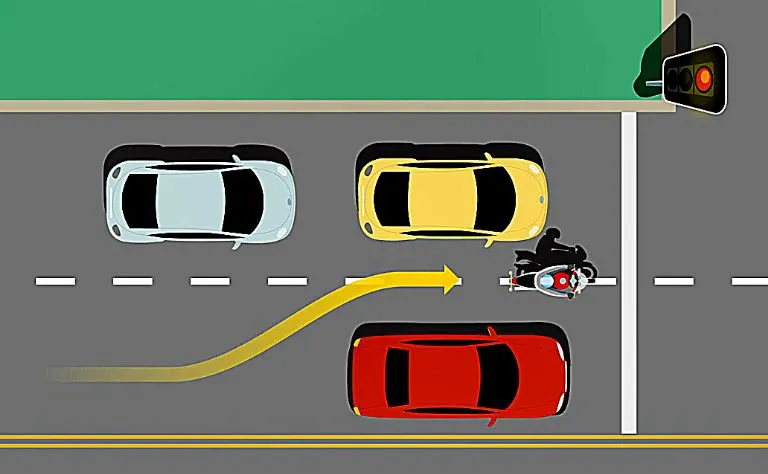
- Lane splitting means riding between lanes of moving traffic, for example along the lane line on the Cross Bronx Expressway.
- Lane filtering means moving between stopped or crawling vehicles, usually to reach the front at a red light.
Some states treat these differently. Utah, Arizona and Colorado ban splitting but allow filtering past stopped vehicles under strict conditions. New York does not draw that line. Subsection (c) bans riding between "adjacent lines or rows of vehicles" whether those vehicles are moving or not, and subsection (b) separately bans passing a vehicle within its lane. There is no speed limit, road type or red-light exception that would make filtering legal.
Other rules that apply
Section 1252 is not the only rule a rider can be cited under:
- VTL § 1128(a), single-lane rule. On a road with marked lanes, a vehicle "shall be driven as nearly as practicable entirely within a single lane" and may not leave it until the driver has made sure the move "can be made with safety." Weaving across lane lines can be ticketed under this section too.
- VTL § 1131, shoulders. Using the shoulder to get past a jam is not a workaround. On state controlled-access highways, no motor vehicle may be driven on the shoulder except where the Department of Transportation has authorized and posted it, or when directed by police or flaggers.
- VTL § 1212, reckless driving. Riding in a way that "unreasonably interferes with the free and proper use of the public highway" or "unreasonably endangers users of the public highway" is reckless driving, a misdemeanor, not just a traffic ticket. Fast splitting through heavy traffic could be charged this way, depending on the facts.
Penalties for lane splitting in New York
Section 1252 does not set its own fine. A violation is a traffic infraction, so the general penalty in VTL § 1800(b)(1) applies to infractions "for which another penalty is not provided":
| Conviction (offences within 18 months) | Maximum fine | Maximum jail |
|---|---|---|
| First | $150 | 15 days |
| Second | $300 | 45 days |
| Third or later | $450 | 90 days |
Jail for a lane-splitting ticket alone is rare, but the statute allows it. Courts also add surcharges and fees on top of the fine.
Licence points. The New York DMV point schedule gives 3 points for "improper passing, unsafe lane change" and 2 points for "any other moving violation." We could not confirm which category the DMV assigns to a § 1252 conviction, so expect 2 or 3 points. The DMV says 6 or more points in 18 months triggers a Driver Responsibility Assessment fee, and 11 points in 24 months can lead to a suspension.
Why it matters after a crash
The ticket is often the smaller cost. If a driver changes lanes into you while you are riding between cars, the other side will argue that you were breaking § 1252.
New York uses pure comparative fault. Under CPLR § 1411, your own "culpable conduct" does not bar recovery, but your damages are "diminished in the proportion" that your conduct bears to the total. In practice, if a jury found you 40% at fault because you were splitting lanes, your award would be cut by 40%.
New York's no-fault system also works differently for riders. The definition of "motor vehicle" in Insurance Law § 5102(f) excludes motorcycles, which is why motorcyclists generally do not get the same no-fault benefits as car occupants and may rely more on a fault-based claim. That makes the fault question even more important. Check your own policy, and see our guide to finding a motorcycle injury lawyer if you have been hurt.
Is New York changing the law?
Not as far as we can find. Unlike Minnesota, which legalized splitting and filtering on July 1, 2025, New York has not passed any change to § 1252. We could not find a 2025–2026 bill to allow lane splitting or filtering that has moved forward, and the current published text of § 1252 still contains the full ban.
If a bill is introduced, it would need to pass both the Senate and the Assembly and be signed by the Governor before taking effect. Until then, treat both splitting and filtering as illegal everywhere in the state, including in New York City.
How New York compares with other states
| State | Riding between moving lanes | Filtering past stopped traffic |
|---|---|---|
| New York | Prohibited (VTL § 1252) | Prohibited |
| California | Allowed (Veh. Code § 21658.1) | Allowed |
| Utah | Prohibited | Allowed under strict conditions until July 1, 2027 |
| Florida | Prohibited (§ 316.209) | Prohibited |
| Michigan | Prohibited (MCL 257.660) | Prohibited |
Read the details in our guides to lane splitting in California, lane filtering in Utah and lane splitting in Michigan.
Riding New York traffic legally and safely
Since you cannot split or filter, the aim is to stay visible and keep an escape route:
- Use your full lane. Section 1252(a) gives you the whole lane, and drivers may not squeeze you out of it.
- Ride two abreast only with one other bike, never three across.
- Pass in an open lane, signalling and checking your mirrors like any other vehicle.
- Stop with space ahead in a queue, slightly off-centre, so you can move if the driver behind is not slowing down.
- Stay off the shoulder on controlled-access highways unless signs or officers direct you onto it.
- Plan around peak traffic where you can, especially on long summer rides when heat builds up in stop-and-go traffic.
If you drive a car, the same law protects riders: do not crowd a motorcycle that is legally using a full lane. If you are also travelling with gadgets in the car, our guide to whether radar detectors are legal in New York covers another common question.
Is lane splitting legal in New York?
No. New York Vehicle and Traffic Law § 1252(c) says no person shall operate a motorcycle between lanes of traffic or between adjacent lines or rows of vehicles, and § 1252(b) bans overtaking and passing in the same lane as the vehicle being passed. Only police officers performing official duties are exempt.
Is lane filtering at a red light legal in New York?
No. Section 1252(c) covers riding between "adjacent lines or rows of vehicles" without any exception for stopped traffic, so moving up between stopped cars at a light is also prohibited.
What is the fine for lane splitting in New York?
Section 1252 has no penalty of its own, so the general traffic infraction penalty in VTL § 1800(b) applies: up to $150 or up to 15 days in jail (or both) for a first conviction, up to $300 for a second within 18 months, and up to $450 for a third. Surcharges and fees are added, and a conviction can put points on your licence.
Can two motorcycles ride side by side in one lane in New York?
Yes. VTL § 1252(a) says the full-lane rule does not prevent motorcycles from being operated two abreast in a single lane, and § 1252(d) bans more than two abreast.
Is New York going to legalize lane splitting?
Not as of October 2026. We could not find a 2025–2026 bill to allow lane splitting or filtering that has moved forward, and the text of § 1252 is unchanged. Any change would have to pass both houses and be signed by the Governor before it took effect.
Sources
- N.Y. Veh. & Traf. Law § 1252 (New York State Senate, Open Legislation)
- N.Y. Veh. & Traf. Law § 1252 (FindLaw copy, current as of January 1, 2026)
- N.Y. Veh. & Traf. Law § 1128 (FindLaw copy, current as of January 1, 2026)
- N.Y. Veh. & Traf. Law § 1131 (FindLaw copy, current as of January 1, 2026)
- N.Y. Veh. & Traf. Law § 1212 (FindLaw copy, current as of January 1, 2026)
- N.Y. Veh. & Traf. Law § 1800 (FindLaw copy, current as of January 1, 2026)
- N.Y. CPLR § 1411 (FindLaw copy, current as of January 1, 2026)
- N.Y. Insurance Law § 5102 (FindLaw copy, current as of January 1, 2026)
- The New York State Driver Point System (New York DMV)

About Farrukh Shahzad
Farrukh Shahzad is the founder and researcher behind TodayinTrend. He is not a lawyer and does not give legal advice — he reads the statutes, court rules and official data, then explains what they actually say in plain English.
Leave a comment
Comments are reviewed before they appear. Please don't share private details about your case.