
Is Lane Splitting Legal in California? What Vehicle Code § 21658.1 Allows
Contents
Last reviewed: October 18, 2026. This article is general information, not legal advice. California can change its Vehicle Code and the CHP can update its guidance; check the current rules before you ride.
If you ride in California, you have almost certainly watched bikes thread between cars on the 405 or the Bay Bridge approach. It is legal here in a way it is legal nowhere else in the US, but "legal" does not mean "anything goes."
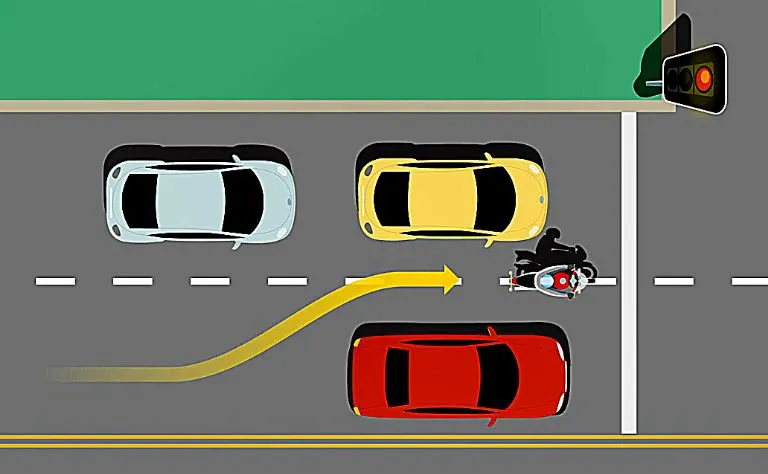
Short answer: Is lane splitting legal in California? Yes. California is the only state with a statute that defines lane splitting: Vehicle Code § 21658.1, added by AB 51 in 2016, covers riding a two-wheeled motorcycle between rows of stopped or moving vehicles. There is no speed cap written into the law, but you can still be ticketed for splitting unsafely, and the California Highway Patrol (CHP) publishes safety tips. For other states, see our state-by-state lane splitting guide.
How AB 51 made it official
For decades, lane splitting in California sat in a grey zone. No law banned it, and no law approved it. Riders relied on the fact that it was not prohibited, and officers relied on general rules when they thought someone was splitting dangerously.
Assembly Bill 51, by Assembly Members Bill Quirk and Tom Lackey, changed that. According to the official bill text, it passed the Senate on August 1, 2016 and the Assembly on August 4, 2016, and Governor Jerry Brown approved it on August 19, 2016 as Chapter 141, Statutes of 2016. It added a single section, § 21658.1, to the Vehicle Code.
The section is short. It does three things:
- Defines lane splitting (subdivision (a)).
- Lets the CHP write educational guidelines on doing it safely (subdivision (b)).
- Requires the CHP to consult the DMV, Caltrans, the Office of Traffic Safety and a motorcycle safety organization when it does (subdivision (c)).
Notice what it does not do: it sets no speed limit, no road-type limit and no penalty. That was deliberate. California chose education over hard numbers.
Splitting vs. filtering in California
- Lane splitting usually means riding between lanes of moving traffic.
- Lane filtering means moving between stopped vehicles, for example to reach the front at a red light.
Most states that allow anything allow only filtering. California's definition covers both, because it says "between rows of stopped or moving vehicles." It also applies on "both divided and undivided streets, roads, or highways," so it is not limited to freeways.
Two limits come straight from the wording:
- Two wheels only. A trike or a motorcycle with a sidecar does not have "two wheels in contact with the ground," so it is outside the definition.
- Between rows of vehicles in the same lane. The shoulder is not a row of vehicles. The CHP's tips say plainly that riding on the shoulder is illegal and is not lane splitting.
The CHP's safety guidance
The CHP released its lane splitting safety tips in September 2018, two years after AB 51 authorized them. As reported by Cycle News, the tips for riders include:
- Consider the total environment: lane width, the size of surrounding vehicles, and road, weather and lighting conditions.
- Danger increases at higher speed differentials (your speed compared with nearby traffic).
- Danger increases as overall speed increases.
- It is typically safer to split between the far left lanes than between other lanes.
- Avoid lane splitting next to large vehicles such as big rigs, buses and motorhomes.
- Be visible, and avoid lingering in other drivers' blind spots or between vehicles.
For drivers, the CHP's messages are that lane splitting by motorcyclists is legal, that intentionally blocking or impeding a motorcyclist is illegal, that opening a door to impede a rider is illegal, and that drivers in the far left lane should move to the left of their lane to give riders room.
What about "10 mph faster" and "under 30 mph"?
You will still see these numbers quoted. They come from earlier CHP tips that the agency removed from its website because, as a CHP spokesman told KCBS, some people read them as laws when they were "merely intended as common-sense traffic safety tips." They advised splitting no more than 10 mph faster than traffic and not splitting when traffic moves at 30 mph or faster. They are sensible rules of thumb, but they are not law, and the current tips do not set numbers.
Can you get a ticket for lane splitting?
Not for lane splitting itself. But the officer can cite the way you were doing it under other sections, for example:
- The basic speed law, § 22350. No one may drive "at a speed greater than is reasonable or prudent having due regard for weather, visibility, the traffic on, and the surface and width of, the highway." Splitting fast through tight lanes can break this even if you are under the posted limit.
- Unsafe lane movement, § 21658(a). On a road with two or more marked lanes in one direction, a vehicle "shall not be moved from the lane until such movement can be made with reasonable safety."
- Posted speed limits and any other moving violation, like any rider.
Fines
Most of these are infractions. Under § 42001(a), the base fine is up to $100 for a first infraction, up to $200 for a second within a year, and up to $250 for a third or more within a year. State and county penalty assessments are added on top, so the amount on the actual ticket is usually much higher than the base fine.
Crashes and fault
Being legal does not make you blameless. If you split at a big speed difference and a car changes lanes into you, an insurer or court can still find you partly at fault. If you have been hurt, see our guide to finding a motorcycle injury lawyer.
How California compares
| State | Riding between moving lanes | Filtering past stopped traffic |
|---|---|---|
| California | Allowed, no set speed cap | Allowed |
| Utah | Prohibited | Allowed at 15 mph or less on roads of 45 mph or less, until July 1, 2027 |
| Texas | Prohibited | Prohibited |
| Washington | Prohibited | Prohibited |
If you ride out of state, your California habits can get you a ticket. See our guides to Texas, Utah's filtering law and Washington.
Practical do's and don'ts
Do:
- Keep your speed close to traffic, and slow down or stop splitting as traffic speeds up.
- Favour the gap between the far left lanes.
- Cover your brakes and watch for turn signals, wheels turning and gaps a car might dart into.
- Wear bright or reflective gear.
Don't:
- Ride on the shoulder.
- Split next to trucks, buses or motorhomes.
- Linger beside a car or in its blind spot.
- Split on a trike or with a sidecar.
Is lane splitting legal in California?
Yes. Vehicle Code § 21658.1, added by AB 51 in 2016, defines lane splitting as riding a two-wheeled motorcycle between rows of stopped or moving vehicles in the same lane, and the California Highway Patrol tells drivers that lane splitting by motorcyclists is legal. You must still ride safely.
Is there a speed limit for lane splitting in California?
No number is written into the law. The CHP's current tips warn that danger rises as overall speed and the speed difference grow. Earlier CHP tips, later withdrawn, suggested no more than 10 mph faster than traffic and not at all when traffic moves at 30 mph or more. Normal speed laws, including the basic speed law in § 22350, still apply.
Can I get a ticket for lane splitting in California?
Not for splitting as such, but you can be cited for riding unsafely while doing it, for example under the basic speed law (§ 22350) or the rule against moving out of a lane unless it is reasonably safe (§ 21658(a)). A first infraction under § 42001 carries a base fine of up to $100, before penalty assessments.
Can I ride on the shoulder to get past traffic?
No. The CHP's lane splitting tips state that riding on the shoulder is illegal and is not lane splitting.
Can a three-wheeled motorcycle or trike split lanes?
No. The definition in § 21658.1 covers only a motorcycle that has two wheels in contact with the ground.
Sources
- Cal. Veh. Code § 21658.1 (California Legislative Information)
- Cal. Veh. Code § 21658.1 (FindLaw copy, current as of January 1, 2026)
- AB 51 (2015–2016), chaptered text, Chapter 141, Statutes of 2016 (California Legislature)
- Cal. Veh. Code § 21658 (FindLaw copy)
- Cal. Veh. Code § 22350 (FindLaw copy)
- Cal. Veh. Code § 42001 (FindLaw copy)
- California Highway Patrol releases lane-splitting tips (Cycle News, September 2018)
- CHP removes lane-splitting guidelines for motorcyclists (CBS San Francisco)

About Farrukh Shahzad
Farrukh Shahzad is the founder and researcher behind TodayinTrend. He is not a lawyer and does not give legal advice — he reads the statutes, court rules and official data, then explains what they actually say in plain English.
Leave a comment
Comments are reviewed before they appear. Please don't share private details about your case.