
You May Legally Block an Intersection? Why the Answer Is Never, and What the Law Says
Contents
Last reviewed: October 12, 2026. This article is general information, not legal advice. Gridlock rules differ in wording from state to state, and some cities add their own signs and fines; check your local rules.
You're on a practice test, and the question reads: "You may legally block an intersection..." followed by a few tempting options, such as "when you entered on a green light" or "during rush hour traffic." It feels like a trick, and it sort of is.
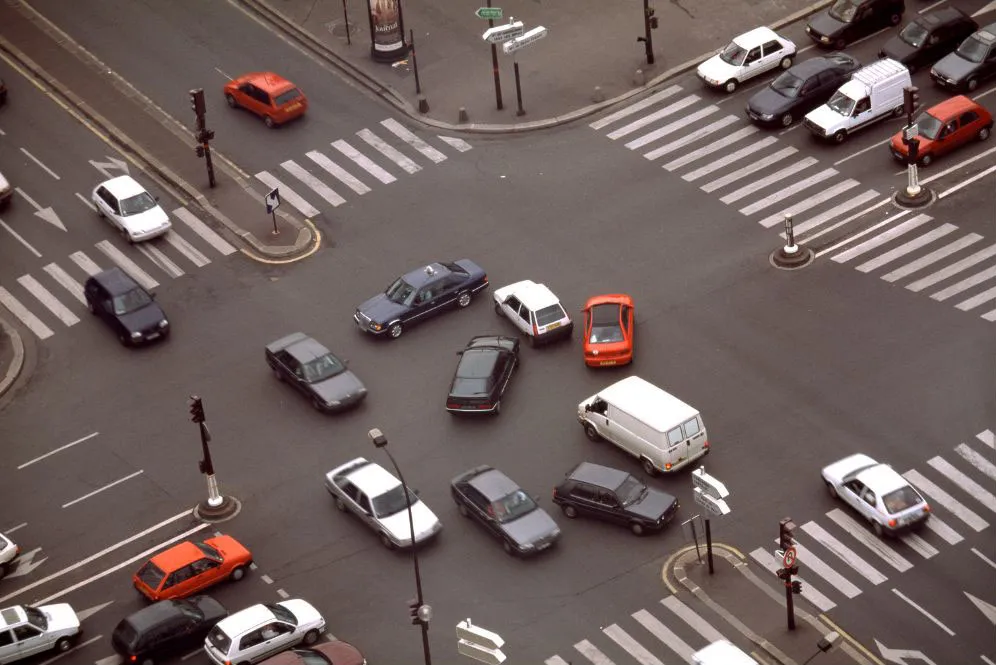
Short answer: You may legally block an intersection never. Anti-gridlock laws, such as California Vehicle Code § 22526 and New York Vehicle and Traffic Law § 1175, say you must not enter an intersection unless there is enough space on the other side for your vehicle, even when the light is green. If traffic is backed up, wait at the stop line until there is room.
Why "never" is the answer
The key words in both statutes are "notwithstanding" a signal to proceed. A green light gives you permission to go if it is safe and there is room. It does not let you pull into the middle of the intersection and hope traffic clears before the light changes.
The California Driver Handbook puts it plainly: "It is against the law to stop or block an intersection where there is not enough space to completely cross before the traffic signal light turns red." It also says that on a solid green light you should "not enter the intersection if you cannot get completely across before the traffic signal light turns red."
Why gridlock laws exist
- Cross traffic gets stuck. One car stranded in the box can stop an entire street when the light changes, and the backup spreads to nearby blocks.
- Crosswalks get blocked. California's rule covers marked crosswalks as well as the intersection itself, so pedestrians are not forced to weave around stopped cars.
- Emergency vehicles need a path. When an ambulance or fire truck approaches with a siren and red light, California drivers must pull to the right-hand edge "clear of any intersection" and stop (§ 21806). That only works if the intersection is clear in the first place.
- Rail crossings are deadly places to get stuck. California's § 22526(c)–(d) bars entering a railroad or rail transit crossing unless there is room on the other side and enough undercarriage clearance.
How the California rule works in detail
In summary, § 22526:
- bans entering an intersection or marked crosswalk without room on the other side, whatever the signal says (subdivision (a));
- applies the same rule to a driver turning on a steady yellow light or yellow arrow (b);
- covers railroad and rail transit crossings (c)–(d);
- lets local authorities post signs at intersections warning of the rule (e); and
- treats a violation as a stopping violation if a peace officer issues a notice to appear, or a parking violation if a parking enforcement officer issues it. It also says a violation is not a violation of a law relating to the safe operation of vehicles (f).
How New York's rule differs
New York's § 1175 has the same core idea: if traffic is stopped on the far side, you may not drive into the intersection unless there is room for your vehicle, regardless of the signal. Its wording carves out vehicles "making a turn," which California's rule does not do in the same way. Local signs and enforcement can add to the state rule, so watch for posted signs at busy intersections.
Are there any exceptions?
The statutes themselves don't list exceptions for a green light, heavy traffic or being late. The real-world situations where you might end up in an intersection are different:
- Directed by an officer or traffic control person. If someone authorized to direct traffic waves you through, follow their directions. In California, it is unlawful to disobey the traffic directions of a person authorized by a local authority to regulate traffic (§ 21100.3), and § 21806 says drivers yield to emergency vehicles "except as otherwise directed by a traffic officer."
- Traffic stopped after you entered. If there was room when you entered and something sudden happened ahead, such as a crash or a stalled vehicle, clear the intersection as soon as you safely can. If you get a ticket, the facts of when you entered can matter, so note them.
- Making room for an emergency vehicle. Move as directed by the rules for yielding, and avoid stopping inside the intersection if you can.
How to avoid blocking the box
- Look past the car in front of you. Before the stop line, check whether there is a full car length of space on the far side.
- Wait at the line, even on green. Drivers behind you may honk; you are following the law.
- Watch for yellow before turning. In California, a turn on yellow still needs room on the other side.
- Never stop on railroad tracks. Wait until there is room on the far side of the crossing.
For the wider rules on who goes first at intersections, see How Does the Law Define Right of Way? CVC 525.
What is the right answer to "You may legally block an intersection..."?
Never. Driver's test questions offer choices like "when you entered on a green light" or "during rush hour," but a green light does not let you enter unless there is room for your vehicle on the other side.
Is it still illegal if the light was green when I entered?
Yes. California Vehicle Code § 22526(a) applies "notwithstanding any official traffic control signal indication to proceed." New York's VTL § 1175 says the same thing. The light tells you when you may go; the space ahead tells you whether you can.
What about turning at an intersection?
In California, a turning driver facing a yellow light or yellow arrow must not enter unless there is space on the other side (§ 22526(b)). New York's § 1175 is worded with an exception for vehicles making a turn, so check the exact rule in your state.
Does a gridlock ticket go on my driving record in California?
Section 22526(f) says a violation is not a violation of a law relating to the safe operation of vehicles. It is treated as a stopping violation when a peace officer issues a notice to appear, or as a parking violation when a parking enforcement officer issues the ticket. Check your citation for the details.
Are railroad crossings covered too?
Yes. In California you must not enter a railroad or rail transit crossing unless there is enough room on the other side for your vehicle, and enough undercarriage clearance to cross, even if a signal tells you to proceed (§ 22526(c)–(d)).
Sources

About Farrukh Shahzad
Farrukh Shahzad is the founder and researcher behind TodayinTrend. He is not a lawyer and does not give legal advice — he reads the statutes, court rules and official data, then explains what they actually say in plain English.
Wow superb blog layout How long have you been blogging for you make blogging look easy The overall look of your site is magnificent as well as the content
Thank you for the feedback.
I am blogging since couple of years now.