
Is Lane Splitting Legal in Colorado? Filtering Rules and the 2027 Repeal
Contents
Last reviewed: October 18, 2026. This article is general information, not legal advice. Colorado's lane filtering law is scheduled to be repealed on September 1, 2027 unless the General Assembly acts; check the current statute before you ride.
Colorado riders know the feeling: a red light on Colfax or a dead stop on I-25, the sun beating down and an air-cooled engine getting hotter by the second. Since August 2024, Colorado has given riders a narrow legal way through that stopped traffic. It is narrower than many people think, and it has an end date.
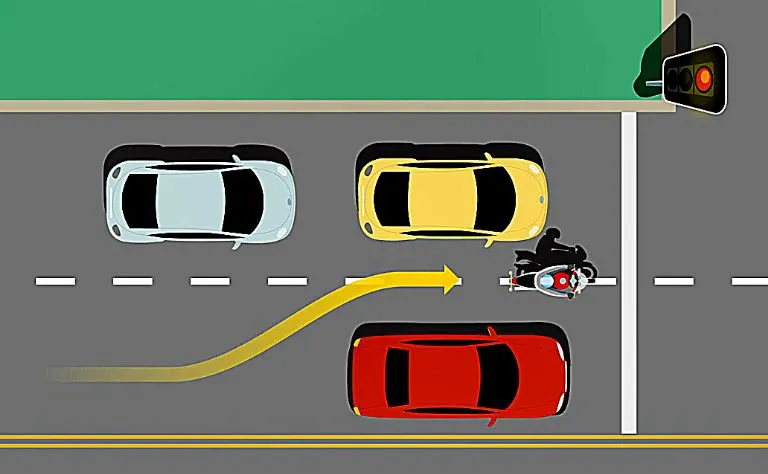
Short answer: Is lane splitting legal in Colorado? No. Riding between lanes of moving traffic is still illegal under C.R.S. § 42-4-1503. But Senate Bill 24-079, in effect since August 7, 2024, allows lane filtering: a two-wheeled motorcycle may pass stopped vehicles in the same lane at 15 mph or less when it is safe. The filtering exception is repealed on September 1, 2027 unless lawmakers extend it. For other states, see our state-by-state lane splitting guide.
The baseline rule: no splitting, no in-lane passing
Before SB24-079, Colorado followed the same model law as many states. Section 42-4-1503 still says:
- (1) motorcycles are entitled to the full use of a traffic lane, and no motor vehicle may be driven so as to deprive a motorcycle of it (this does not apply to two motorcycles riding two abreast);
- (2) a motorcycle or autocycle driver "shall not overtake or pass in the same lane occupied by the vehicle being overtaken";
- (3)(a) a person "shall not drive a motorcycle or autocycle between lanes of traffic or between adjacent lines or rows of vehicles";
- (4) motorcycles may not ride more than two abreast in one lane;
- (5) subsections (2) and (3) do not apply to police officers on duty.
The 2024 law did not repeal these rules. It added a narrow exception in subsection (3)(b). Anything outside that exception, including true lane splitting in moving traffic, is still banned.
The five conditions for legal filtering
You may pass another vehicle in your lane only if all of these are true:
- You are on a two-wheeled motorcycle. Autocycles and three-wheelers are not covered.
- The vehicle you are passing is stopped.
- Vehicles in the adjacent same-direction lanes are also stopped.
- The lanes are wide enough to pass safely.
- You are riding at 15 mph or less, and conditions permit "prudent operation."
The law adds two more rules:
- Stop when traffic moves. Under § 42-4-1503(3)(b)(II), when the vehicles you are passing begin moving, you "shall cease" filtering. You cannot keep going between cars as traffic picks up.
- Where you may not filter. Under (3)(b)(III), you may not pass on the right shoulder, to the right of a vehicle in the farthest right-hand lane if the highway is not limited access, or in a lane of traffic moving in the opposite direction.
The Colorado Department of Transportation sums up its guidance in five rules, including that "traffic must be at a complete stop," "the motorcycle must go 15 mph or less," and "the rider must pass on the left and not enter the oncoming traffic lane." CDOT explains that "it's easier for drivers to see riders approaching on the left side."
How Colorado compares with other filtering states
Colorado's law has no speed-limit or road-type condition, unlike Utah and Arizona, which allow filtering only on roads posted at 45 mph or less. On the other hand, Colorado requires traffic in the adjacent lanes to be stopped too, and gives no allowance for crawling traffic.
| State | What is allowed | Key conditions |
|---|---|---|
| Colorado | Filtering only | Passed and adjacent vehicles stopped; motorcycle 15 mph or less; no right shoulder or oncoming lane. Repealed September 1, 2027. |
| Utah | Filtering only | Vehicle passed is stopped; road 45 mph or less (or off-ramp); 15 mph or less. Set to be repealed July 1, 2027. |
| Arizona | Filtering only | Vehicle passed is stopped; road 45 mph or less with 2+ lanes each way; 15 mph or less. |
| Montana | Filtering only | Vehicle passed is stopped or at 10 mph or less; motorcycle not above 20 mph. |
| Minnesota | Splitting and filtering | 25 mph or less and no more than 15 mph faster than traffic. |
| California | Lane splitting | Between stopped or moving vehicles; no statutory speed cap. |
Read more in our guides to lane filtering in Utah and lane splitting in California. If you ride into Texas or Missouri, note that both ban riding between lanes: see lane splitting in Texas and lane splitting in Missouri.
The September 1, 2027 repeal
SB24-079 was signed on April 4, 2024 and took effect on August 7, 2024. It was written as a trial:
- Sunset: subsection (3)(b), the filtering exception, "is repealed, effective September 1, 2027."
- Safety report: under subsection (3)(c), CDOT must analyse the safety effects and report to the General Assembly by January 1, 2027. The report must cover motorcycle rear-end collisions, the severity of rear-end collisions in heavy traffic, and side-swipe collisions while filtering, before and after August 7, 2024.
The General Assembly's 2027 session begins in January, after that report is due. As of October 2026, we found no bill that has extended the sunset. If nothing passes, filtering becomes illegal again on September 1, 2027, and the general ban in § 42-4-1503(2) and (3)(a) applies to all in-lane passing.
Penalties and fault
The ticket. Under § 42-4-1503(6), any violation of the section is a class A traffic infraction. The penalty schedule in § 42-4-1701(4) lists a $30 penalty and a $6 surcharge for a § 42-4-1503 violation.
Careless driving. Filtering at speed or weaving through moving cars can be charged more seriously. Under § 42-4-1402, driving "in a careless and imprudent manner, without due regard for the width, grade, curves, corners, traffic, and use of the streets" is careless driving, a class 2 misdemeanor traffic offense, or a class 1 misdemeanor traffic offense if it causes injury or death. The legislature itself noted, in the bill's declaration, that filtering before 2024 could lead to citations for "careless driving."
Fault after a crash. Colorado uses modified comparative negligence. Under C.R.S. § 13-21-111, your own negligence does not bar recovery "if such negligence was not as great as the negligence of the person against whom recovery is sought," but your damages are reduced by your share. If you are found equally or more at fault, you recover nothing. Filtering outside the statute, such as at 25 mph or between moving cars, gives the other side an easy argument. See our guide to finding a motorcycle injury lawyer if you have been hurt.
Practical tips for Colorado riders
- Filter only in fully stopped traffic, and stop as soon as cars start rolling.
- Keep your speed at 15 mph or less while passing. That limit is your speed, not the speed difference.
- Pass on the left of the vehicle ahead, as CDOT advises.
- Never use the right shoulder or cross into oncoming lanes.
- Watch for opening doors, cars nudging over and drivers who do not know the law is new.
- Do not filter on a trike or autocycle. The exception covers two-wheeled motorcycles only.
- Check the law again in 2027. The rules may change or end after the CDOT report and the 2027 session.
If you drive a car, CDOT asks drivers to "treat riders with courtesy as they practice lane filtering." Keep your door shut and your lane steady in stopped traffic.
Is lane splitting legal in Colorado?
No. Riding between lanes of moving traffic is still banned by C.R.S. § 42-4-1503(3)(a). Since August 7, 2024, Colorado allows only lane filtering: a two-wheeled motorcycle may pass stopped vehicles in the same lane at 15 mph or less when conditions are safe.
What are the rules for lane filtering in Colorado?
Under § 42-4-1503(3)(b), the vehicle you pass must be stopped, vehicles in adjacent same-direction lanes must be stopped, the lanes must be wide enough to pass safely, you must ride at 15 mph or less, and conditions must permit prudent operation. You must stop filtering when traffic starts moving, and you may not use the right shoulder or an oncoming lane.
When does Colorado's lane filtering law expire?
The filtering exception in § 42-4-1503(3)(b) is repealed effective September 1, 2027. Unless the General Assembly extends it before then, filtering becomes illegal again on that date. CDOT must report to lawmakers on its safety effects by January 1, 2027.
What is the fine for illegal lane splitting in Colorado?
A violation of § 42-4-1503 is a class A traffic infraction. The penalty schedule in § 42-4-1701(4) lists a $30 penalty plus a $6 surcharge. Riding carelessly can instead be charged as careless driving under § 42-4-1402, a class 2 misdemeanor traffic offense.
Can I filter on the highway in Colorado?
Colorado's law has no road-type or speed-limit condition, so filtering is not limited to city streets. But every vehicle beside you must be stopped, and you must stop filtering as soon as traffic moves. On roads that are not limited-access highways you also may not pass to the right of a car in the far right lane.
Sources
- SB24-079, Motorcycle Lane Filtering & Passing (Colorado General Assembly)
- SB24-079 as signed, Session Laws 2024, Chapter 40 (Colorado General Assembly)
- C.R.S. § 42-4-1503 (FindLaw copy, current as of January 1, 2025)
- C.R.S. § 42-4-1701, penalty schedule (FindLaw copy, current as of January 1, 2025)
- C.R.S. § 42-4-1402, careless driving (FindLaw copy, current as of January 1, 2025)
- C.R.S. § 13-21-111, comparative negligence (FindLaw copy, current as of January 1, 2025)
- Motorcycle Lane Filtering (Colorado Department of Transportation)

About Farrukh Shahzad
Farrukh Shahzad is the founder and researcher behind TodayinTrend. He is not a lawyer and does not give legal advice — he reads the statutes, court rules and official data, then explains what they actually say in plain English.
Leave a comment
Comments are reviewed before they appear. Please don't share private details about your case.