
How Much Do Law Professors Make? Salaries by School Type, Rank and State
Contents
Last reviewed: October 6, 2026. This article is general information, not legal or career advice. Salary figures are government survey estimates; an individual professor's pay depends on the school, rank and contract.
If you're thinking about teaching law, or you're simply curious what the people at the front of the lecture hall earn, the best starting point is federal wage data. It won't tell you what one particular school pays, but it shows the realistic range and where the money tends to be.
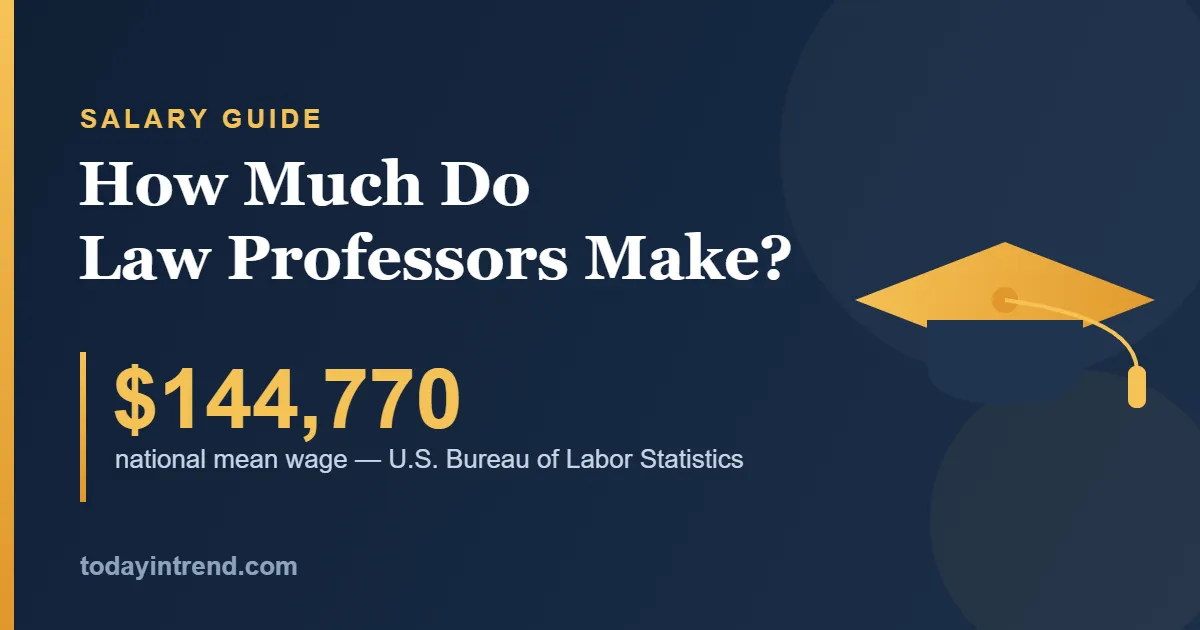
Short answer: How much do law professors make? In May 2025, the U.S. Bureau of Labor Statistics (BLS) estimated that postsecondary law teachers earned a median of $128,500 a year and a mean (average) of $144,770. The middle half earned roughly $88,700 to $176,490, and average pay is higher at universities and professional schools than at junior colleges.
The full pay range for law teachers
Averages hide a lot. Here is how BLS reports the spread of annual wages for law teachers in May 2025:
| Percentile | Annual wage |
|---|---|
| 10th percentile | $64,250 |
| 25th percentile | $88,700 |
| 50th percentile (median) | $128,500 |
| 75th percentile | $176,490 |
| 90th percentile | $287,900 |
| Mean (average) | $144,770 |
Read it like this: one in ten law teachers earned less than $64,250, and one in ten earned more than $287,900. The mean sits above the median because a smaller group of very well-paid professors pulls the average up.
Universities pay more than junior colleges
Almost all law teachers work at colleges, universities and professional schools, which is where law schools sit. BLS breaks the May 2025 figures down by type of employer:
- Colleges, universities and professional schools: about 19,110 jobs, mean annual wage $147,040.
- Junior colleges: about 910 jobs, mean annual wage $101,020.
BLS data does not split public from private law schools, so there is no reliable official figure for that comparison. Pay differs a lot between individual schools, so check the specific institution. Salaries at public universities are often available through state public-records laws, which can be a useful way to see real numbers.
How rank and tenure affect pay
Law faculty usually follow the standard academic ladder. The BLS handbook explains that earning tenure "may take up to 7 years of progressing through the positions by rank: assistant professor, associate professor, and professor."
- Assistant professors are new tenure-track hires and usually earn the least of the three ranks.
- Associate professors have typically been promoted, often with tenure.
- Full professors are the most senior and usually the best paid. Named or endowed chairs can carry extra pay.
- Clinical and legal writing faculty may be on different contracts, sometimes outside the tenure track, and their pay can differ from other faculty at the same school.
- Adjuncts and visiting faculty are usually paid per course or for a fixed term. The handbook notes that "An active lawyer or judge might teach an evening course at a law school."
BLS does not publish law-specific salaries by rank, so be cautious with any website that gives an exact "assistant law professor salary" without naming the survey behind it.
Pay by state
State averages vary widely, partly because of cost of living and partly because of which schools are located there. Mean annual wages for law teachers in selected states, May 2025:
| State | Mean annual wage |
|---|---|
| Michigan | $173,330 |
| Massachusetts | $168,350 |
| New York | $168,030 |
| New Jersey | $156,120 |
| Virginia | $154,250 |
| Texas | $151,140 |
| District of Columbia | $144,650 |
| California | $139,140 |
| Illinois | $136,280 |
| Florida | $131,220 |
| Pennsylvania | $129,520 |
A few cautions: state estimates are based on smaller samples than the national figure, so they can move noticeably from one year to the next, and BLS does not publish a wage estimate for every state.
How law professor pay compares with practising law
BLS reports a median annual wage of $159,670 for lawyers in May 2025, above the $128,500 median for law teachers. People who choose teaching often trade a higher firm salary for academic freedom, research and a different pace of work. Some professors also earn outside income from consulting, writing or expert-witness work, which BLS wage data does not capture.
What it takes to become a law professor
- A J.D. from an accredited law school is the usual baseline. If you are still at the application stage, see how many law schools you should apply to.
- Strong academic credentials, such as law review membership and excellent grades.
- Scholarship: published articles, or a clear plan for them, matter a lot for tenure-track hiring.
- Experience: many professors have clerked for a judge, practised for several years or completed a teaching fellowship. Many have also passed the bar.
If you are deciding whether law school is worth it in the first place, our guide on why to study law covers costs, bar passage and job outcomes.
What is the average salary of a law professor in the US?
According to the Bureau of Labor Statistics, postsecondary law teachers had a mean annual wage of $144,770 and a median of $128,500 in May 2025. These figures include everyone BLS classifies as a law teacher, from new instructors to senior tenured professors.
Do law professors make more than lawyers?
Not on average. BLS reports a median annual wage of $159,670 for lawyers in May 2025, compared with $128,500 for law teachers. Individual pay overlaps a lot: senior professors at well-funded schools can out-earn many practising lawyers, while partners at large firms usually earn far more than any professor.
How much do adjunct law professors make?
Adjuncts are often practising lawyers or judges who teach a single course, and they are usually paid per course rather than a full salary. Rates are set by each school and are not broken out in BLS data, so ask the school directly if you are considering adjunct work.
What degree do you need to be a law professor?
The BLS handbook says law teachers typically need a doctoral degree, and in practice that is usually the J.D., the same professional degree practising lawyers earn. Some law professors also hold a PhD in another field. Hiring committees also weigh published scholarship, grades, clerkships and practice experience.
Sources

About Farrukh Shahzad
Farrukh Shahzad is the founder and researcher behind TodayinTrend. He is not a lawyer and does not give legal advice — he reads the statutes, court rules and official data, then explains what they actually say in plain English.
Leave a comment
Comments are reviewed before they appear. Please don't share private details about your case.